Most plants still treat cameras as after the fact recorders. Useful for investigating an incident, not so useful for preventing the next one. In 2025, the better approach is to turn video into a live safety sensor that helps supervisors spot PPE non-compliance and near miss events before they turn into injuries or downtime.
At SSP, we help manufacturers upgrade from basic CCTV to AI safety analytics that work in real time. The goal is simple. Give EHS and operations teams timely, actionable alerts without drowning them in noise. Here is how it works, what to watch for, and how to roll it out with measurable value.
j
j
What safety intelligence actually does
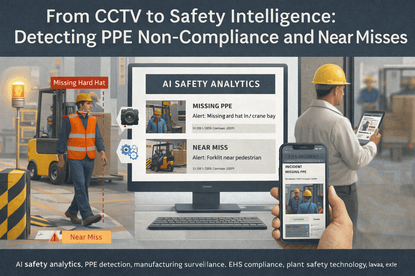
PPE detection. Models identify hardhats, eyewear, vests, gloves, hearing protection, and respirators in defined zones. If a worker enters a crane bay without a hardhat or approaches a chemical room without a respirator, the system flags it and can trigger a local strobe or audible message.
Near miss recognition. Analytics look for risky motion patterns such as a person stepping into a forklift aisle, loitering in a pinch point, crossing a safety line, or slipping and falling. The system bookmarks the clip, sends a short alert, and provides context for coaching.
Unsafe state alerts. Doors ajar on hazardous storage, blocked fire exits, vehicles reversing into no-go zones, or pallets left in evacuation routes can all be detected with the right rules.
Evidence for coaching and audits. Every alert links to a short clip with time, camera, and zone. Supervisors coach with facts. EHS closes findings with proof. Claims investigators get clean documentation.
k
k
Where to deploy first
Start with zones that combine risk and repeat exposure.
-
Forklift and pedestrian crossings. Dock doors, end caps, and blind corners.
-
Overhead crane bays and fabrication cells. Hardhat and eyewear checks.
-
Chemical rooms, paint lines, and freezer doors. Respirator or coat compliance.
-
Maintenance shops and tool cribs. Eye and hand protection detection.
-
Shipping lanes and staging. Trip and slip monitoring around stretch wrap and banding.
Place cameras to see the full body and PPE clearly. Use stable lighting and avoid backlight that hides helmets or visors.
k
k
How alerts reach the right people
-
Local. Stack light, horn, or display panel near the risk zone.
-
Mobile. SMS or app push to the on-duty supervisor with a ten second clip.
-
Command. Event tiles in the VMS or PSIM so security can review and escalate.
-
Workflow. Auto create a corrective action in your EHS platform with the clip attached.
Integrations matter. SSP ties video analytics, access control, and mass notification so the right team sees the right alert at the right time.
j
j
Making AI useful and not noisy
False alerts kill adoption. Use these tuning practices.
-
Define zones tightly. Only analyze the floor space where PPE is required.
-
Use schedules. Different rules for production, sanitation, and shutdown.
-
Minimum dwell. Alert only if a person remains non-compliant for a few seconds.
-
Confidence thresholds. Set higher thresholds for gloves and eyewear, lower for hardhats which are easier to detect.
-
Escalation ladder. First a local cue, then a supervisor ping, then a radio call if the condition persists.
k
k
Privacy and acceptance on the plant floor
Workers accept safety analytics when you are clear about intent and limits.
-
State the purpose is safety coaching and incident prevention.
-
Share what is logged and what is not. No performance scoring or biometrics.
-
Post signage and include the zones in your EHS policy.
-
Involve operators in tuning. When alerts help them, adoption sticks.
k
k
What to measure in the first 60 days
-
PPE compliance rate by zone and shift
-
Time to intervention from alert to supervisor contact
-
Near miss rate and trend line after coaching
-
Blocked exit or door-ajar events resolved within target time
-
Claim and first aid case reductions quarter over quarter
-
Alert precision percentage of alerts that required action
These KPIs show both safety improvement and operational ROI.
k
k
Common pitfalls and how to avoid them
-
Poor angles and glare. Re-aim or add diffused lighting so PPE is visible.
-
One policy for all areas. Write zone specific rules that match hazards.
-
No owner for follow up. Assign a supervisor per zone with a simple checklist.
-
Treating it as a security project only. Make it an EHS and operations initiative with joint success metrics.
k
k
How this fits your broader manufacturing security stack
Safety intelligence complements your manufacturing access control, tool crib protection, and perimeter surveillance. When a restricted door is opened without a badge, the video bookmark is already there. When a forklift almost clips a pedestrian, the clip and location feed your safety stand-up the next morning. It is one ecosystem that improves both risk reduction and throughput.
k
k
The SSP approach
SSP designs and supports AI-ready video systems for plants that want proactive safety. We start with a short design workshop, deploy analytics to your highest risk zones, integrate alerts with your EHS workflow, and monitor system health 24 by 7 so footage and alerts are there when you need them.
Discover how SSP keeps manufacturing operations secure and operational.
Contact us to schedule a plant safety analytics assessment and pilot plan.