Every manufacturing site has places that feel invisible once the day shift ends. The back lot where pallets stack up. The dark corner of the yard behind shipping. The equipment cage no one checks until morning. These spaces become targets after hours, and traditional cameras that only record are not enough.
Remote video monitoring gives you real-time oversight of those unmanned zones when people are off the clock. Instead of hoping to catch an incident on playback, you can detect, verify, and respond in the moment.
This guide explains how remote monitoring works for manufacturing facilities, what problems it solves, and how to integrate it with your existing plant surveillance systems for stronger industrial site security.
k
k
What is Remote Video Monitoring
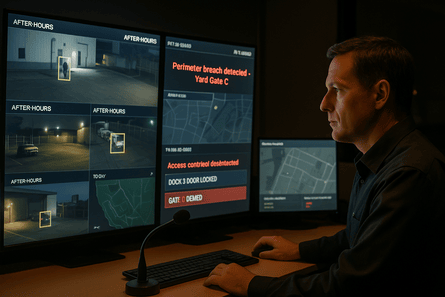
Remote video monitoring combines your cameras with live, event driven oversight from a monitoring center or in house security team. Analytics on the camera or video platform identify activity and trigger alerts. Trained operators review the event, talk down through speakers if needed, and escalate to on site contacts or law enforcement.
Think of it as turning your cameras into a 24 by 7 patrol that never gets tired, never misses a handoff, and documents everything.
k
k
Why Unmanned Zones Need Special Attention
Unmanned areas are risky because they sit outside normal workflows. No foot traffic. Limited lighting. Minimal deterrence. Common issues include:
-
Theft of copper, tools, or spares from outdoor storage
-
Vandalism at rear fences or remote gates
-
After hours trespassing around fuel tanks and loading docks
-
Equipment tampering that causes costly downtime the next day
-
Unauthorized contractor access during off hours
A standard recorder will show what happened. Remote monitoring helps stop it as it happens.
k
k
How Remote Monitoring Works in a Manufacturing Environment
-
Define zones and schedules
Tag the places that are unstaffed after hours, such as laydown yards, rail spurs, tank farms, roof access points, and auxiliary buildings. Create time windows for higher sensitivity. -
Deploy video analytics
Use human and vehicle detection, line crossing, object left behind, and loitering rules. Analytics reduce false alarms from wildlife or moving shadows and focus on meaningful activity. -
Set voice down and lighting responses
Pair speakers and controllable lighting with cameras. When a verified event occurs, an operator can issue a live warning and bring lights to full brightness to deter the intruder. -
Escalate with clear runbooks
If a person does not leave, operators follow a site specific playbook. Options include notifying on call supervisors, contacting a contracted guard, or requesting police response. -
Capture audit trails
Every alert, clip, talk down, and dispatch is time stamped. These records support investigations, insurance claims, and process improvements.
k
kk
Where Remote Monitoring Delivers the Most Value
-
Perimeter fencing and back gates
Detect climbing, cutting, or tailgating before a breach spreads into the yard. -
Outdoor storage and laydown areas
Watch pallets, metals, molds, and spares that are hard to inventory daily. -
Fuel, chemical, and tank farm zones
Add a layer of protection around hazardous areas and environmental liability. -
Roof access and mechanical yards
Protect chillers, compressors, and telecom gear from tampering. -
Shipping docks and trailer lots
Monitor yard moves, prevent pilferage, and document chain of custody.
k
k
Remote Monitoring vs On Site Guards
Both have a place. Here is how they differ so you can choose the right mix.
-
Coverage and scalability
Remote monitoring can watch dozens of cameras across a large campus at once. Guards are limited by patrol routes and line of sight. -
Cost profile
After hours coverage with live operators often costs less than overnight guard staffing, especially for multi building sites. -
Deterrence and response
Guards provide physical intervention. Monitoring provides instant detection, live warnings, and guided response. Many facilities use a hybrid model where remote agents direct roving guards when needed.
k
k
Integrating Remote Monitoring with Factory Access Control
Remote video is strongest when it is connected to your other systems.
-
Door and gate events
Link badge activity to nearby cameras for instant visual verification of off hours access. -
Alarm and sensor inputs
Tie intrusion, fence vibration, or outdoor motion sensors to camera call ups and operator alerts. -
Mass notification
If a larger threat is detected, operators can trigger site messages and contact lists according to your runbook. -
Incident reporting
Centralize video clips, access logs, and operator notes in one case file for EHS, HR, or insurance.
l
l
Reducing False Alarms Without Missing Real Threats
False alarms are the reason many teams hesitate to adopt live monitoring. You can minimize noise with a few design choices.
-
Calibrate analytics per zone and time of day
-
Use human and vehicle classifiers rather than simple motion
-
Add masking for moving foliage or roadways beyond the fence
-
Pair analytics with fence or gate sensors for layered confirmation
-
Set talk down as the first response to gauge intent before dispatch
l
l
Measuring ROI for Plant Surveillance Systems
Quantify results so the program survives budget season.
-
Incident reduction
Track before and after rates of trespass, theft, and vandalism. -
Downtime avoided
Assign dollar values to prevented equipment damage and delayed production. -
Guard optimization
Replace or supplement static posts with targeted response directed by remote operators. -
Insurance position
Documented detection and response often improves carrier confidence and may influence premiums.
l
l
A Practical Implementation Checklist
-
Map unmanned zones and risk levels
-
Validate lighting, angle of view, and camera health
-
Turn on analytics and tune for the environment
-
Add speakers and test live talk down
-
Write a simple escalation playbook with phone trees
-
Pilot on the highest risk area for thirty days, then expand
l
l
How SSP Can Help
SSP designs remote video monitoring programs for manufacturing facilities that need reliable after hours coverage without ballooning guard costs. Our team audits your current plant surveillance systems, identifies high risk unmanned zones, enables analytics, and connects everything to a live monitoring workflow that fits your operations and EHS requirements.
The goal is simple. Detect sooner, verify faster, and respond with confidence while your people get the rest they need.
l
l
Ready to protect your unmanned zones after hours
Let’s walk your site virtually and identify the best starting point.
Learn how SSP helps manufacturers protect operations, people, and property.