In a hospital, seconds matter. When a patient falls, a behavioral health situation escalates, or a staff member feels unsafe, the speed and clarity of the response can make all the difference.
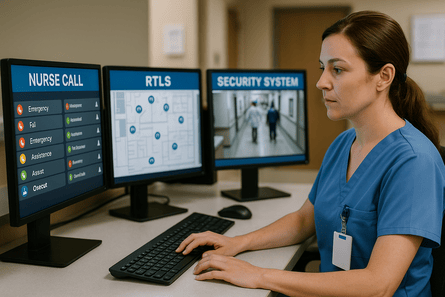
Most hospitals already have strong pieces of the puzzle in place: a nurse call system, an RTLS platform, hospital security systems with cameras, and healthcare access control at key doors. The challenge is that these systems often work in parallel rather than together.
When nurse call, real time location systems (RTLS), access control, and HIPAA compliant surveillance are integrated into a single response workflow, hospitals can see more, decide faster, and send help to exactly the right place. That integration is where a security partner like SSP adds real value.
j
j
The Building Blocks: Nurse Call, RTLS, and Security Technologies
Before talking about integration, it helps to define the core systems.
Nurse call systems
Nurse call platforms are designed for clinical communication. Patients press a button. Staff receive alerts at the station, through handheld devices, or on hallway indicators. These systems are tuned for clinical workflows, rounding, and patient requests.
RTLS in hospitals
Real time location systems (RTLS) use badges, tags, or sensors to show the location of staff, patients, or equipment throughout the facility. RTLS can support:
-
Staff safety, by tracking the location of duress alerts
-
Patient flow and elopement prevention
-
Equipment tracking for pumps, monitors, and specialty devices
Hospital security systems
Security technology in a hospital usually includes:
-
Healthcare access control for doors, gates, and secure units
-
Video surveillance with HIPAA compliant storage and retention
-
Intrusion detection or environmental alarms in critical areas
Each of these systems works well on its own. The real power comes when they share information and trigger coordinated responses.
j
j
Why Integration Matters
When systems are not integrated, staff and security teams often work from partial information. A nurse may see a call request without knowing who is closest. Security may see a door forced alarm without context on who is there or whether there is a clinical issue nearby.
Integration creates a common operating picture.
A simple example:
-
A patient fall alarm from a nurse call device
-
RTLS data showing which nurse or tech is closest
-
Camera views near the room available to security if help is requested
-
Access control rules that can temporarily allow a rapid response team into the area
This is the difference between responding in steps and responding as one coordinated team.
j
j
Key Use Cases for Integrated Nurse Call, RTLS, and Security
1. Responding to patient falls and clinical emergencies
When a patient falls or presses an emergency pull cord, the first goal is to get clinical staff to the room. Integrated systems can:
-
Send an alert through the nurse call platform
-
Use RTLS to identify which staff member is closest and route the alert directly to them
-
Notify security if the event meets predefined safety criteria, for example in behavioral health or high risk units
-
Provide immediate access to camera views near the room for situational awareness, if appropriate for that unit
This reduces response time and helps coordinate care and safety in parallel.
2. Supporting staff duress and workplace violence response
When a nurse or clinician triggers a duress badge, the response must be fast and precise. Integrating RTLS with hospital security systems allows:
-
Automatic identification of the exact room or zone where the duress alert originated
-
Alerts to both security and unit leadership in real time
-
Instant pull up of nearby cameras for security to assess risk
-
Adjustments to healthcare access control, such as securing nearby doors or opening a controlled entrance for responding security officers
This is far more effective than a generic overhead code that only provides a unit name.
3. Managing patient elopement and wandering risks
In behavioral health, memory care, and certain medical units, elopement is a serious concern. Integrated systems can combine:
-
RTLS tags or specialized patient protection systems
-
Door contacts and access control
-
Video analytics at exits
When a high risk patient approaches or passes through a restricted door, the hospital can generate:
-
A nurse call alert to assigned staff
-
A security event at the control room
-
A camera bookmark for later review
-
Optional local alarms to deter continued movement
This approach protects patients without relying solely on constant line of sight observation.
4. Coordinating response in the emergency department
The emergency department is one of the most dynamic and high risk areas in the hospital. Integrating nurse call, RTLS, and security can help in situations such as:
-
Escalating agitation or aggression in a treatment bay
-
Family disputes in waiting areas
-
Overflow and crowding that increase safety risk
When a staff member signals a concern, RTLS and cameras can show who is nearby, how crowded the area is, and whether additional support is needed, all while access control helps manage entries and exits into treatment areas.
j
j
What Integration Looks Like Technically
There is no single way to integrate nurse call, RTLS, and security, but most projects involve several consistent elements.
Shared event handling
Each system can generate events: a nurse call, an RTLS badge press, a door forced alarm. Integration means these events can flow into a shared platform or rules engine that decides:
-
Who to notify
-
What devices to activate, such as message boards or mobile notifications
-
Whether to trigger corresponding actions in other systems
Context aware alerts
Instead of every event going everywhere, integration allows for context. For example:
-
A nurse call alert in a low risk area may stay within the clinical workflow
-
A duress alert in the ED or behavioral health unit may automatically alert security and pull camera feeds
-
A door alarm on a pediatric floor might always generate both clinical and security awareness
Common mapping and naming
Integrating systems also requires a shared understanding of locations. Room numbers, zones, units, and doors must be mapped consistently across nurse call, RTLS, access control, and video so that when an alert appears, everyone is literally on the same page.
This mapping work is often where an integrator like SSP provides significant value.
j
j
Benefits for Clinical, Security, and Leadership Teams
For clinical teams
-
Faster backup when situations feel unsafe
-
Clearer visibility into which team member is closest to respond
-
Less time spent explaining where help is needed
For security teams
-
Better information before arriving at an incident
-
Fewer false alarms and more context for each alert
-
Ability to verify situations through HIPAA compliant surveillance where appropriate
For leadership and compliance
-
Stronger support for workplace violence prevention programs
-
Better documentation of incident response, timing, and actions
-
Improved alignment with Joint Commission and CMS expectations around staff and patient safety
jj
j
Considerations When Planning Integration
Hospitals do not need to rip and replace everything to benefit from integration. Instead, most start with focused use cases and grow from there. Key planning questions include:
-
Which units or departments have the highest need for integrated response
-
What systems are already in place and which have open interfaces or integration support
-
How will alerts be prioritized so that staff are not overwhelmed
-
How will privacy and HIPAA requirements be protected when video is involved
Working with a security integrator that understands both healthcare access control and the clinical environment is critical. The goal is to support care, not add noise.
j
j
How SSP Can Help
SSP specializes in bringing hospital security systems together so they work as one. That includes:
-
Integrating nurse call, RTLS, and duress solutions with healthcare access control and video surveillance
-
Designing alert workflows and escalation paths that fit your units and risk profile
-
Mapping locations and devices across systems to keep naming consistent
-
Supporting long term planning so integrations stay aligned with new wings, clinics, or technology upgrades
The result is a response model that is quicker, more coordinated, and easier for staff to trust.
j
j
Conclusion
Nurse call systems, RTLS, and hospital security systems all serve important roles on their own. When they are integrated, they become something more powerful: a unified safety and response network that protects patients and the people who care for them.
By connecting alerts, location data, access control, and HIPAA compliant surveillance into one workflow, hospitals can shorten response times, reduce risk, and create a safer environment across every unit.
Talk to SSP about integrating nurse call, RTLS, and security technologies into a single, coordinated response strategy that supports your clinical teams and strengthens your overall hospital security program.